


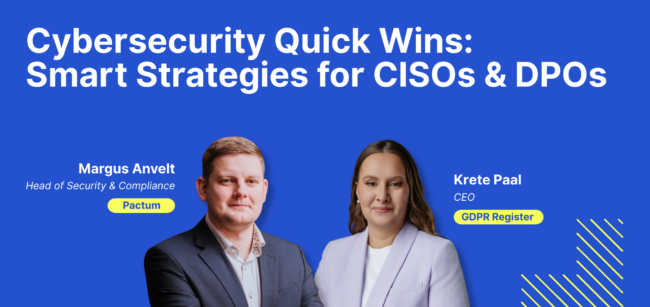
Cybersecurity Quick Wins: Smart Strategies for CISOs & DPOs
Agenda and topics Staying ahead of cyber threats in 2025 requires more than expensive tools—it’s about mastering the basics and […]

Privacy and AI work remain demanding, and the value of a privacy professional increasingly depends on continuous learning. Upskilling goes far beyond passing certification exams. Real impact comes from translating knowledge into day-to-day execution within a company.
Consistency matters more than intensity. A structured routine makes progress possible regardless of time or energy constraints. A daily habit of reviewing current materials helps maintain competence, including:
Even a fixed 30-minute daily block helps professionals stay current in a fast-moving regulatory landscape.
Certifications can support career progression, but they do not prove real-world capability. In practice, exams mainly demonstrate the ability to pass that exam.
A common mismatch appears:
Certifications add value, but they do not replace judgement, experience, or the ability to advise a business in practice.
Practical privacy work requires more than reading summaries. A stronger approach includes:
This is especially important for operational tasks such as building a register of processing activities. Knowing that a register is required is not the same as creating one that integrates with HR, IT, vendors, and business workflows—particularly in smaller companies with limited budgets.
A mentor with hands-on experience can significantly reduce trial-and-error. The most valuable mentors are active practitioners, not only trainers or recent exam passers.
What to look for:
Ways to find them:
AI-generated content has made it harder to distinguish real expertise, so verification matters more than ever.
Certification choices should follow where the work is done.
Guiding principle: start with the jurisdiction where the role operates.
European privacy frameworks offer a strong foundation due to their structure and terminology. Once established, expanding to other regions becomes easier.
A typical path may include:
Applying a purely European approach in the US can create compliance risks, particularly around FTC enforcement, so regional differences must always be respected.
AI certifications can be useful, but only after building strong privacy fundamentals. AI exams often rely on:
Without a solid privacy base, the scope quickly becomes unmanageable.
Preparation approaches generally fall into four categories:
Passing exams requires understanding question structure, including theory-based and scenario-based questions. Elimination strategies are essential, particularly for non-native English speakers. Some exams also rely heavily on jurisdiction-specific terminology, which requires focused preparation.
Modern privacy roles require more than legal knowledge:
Privacy compliance is a long-term effort. The function works best when embedded across the business, acting as an advisor and enabler rather than the sole decision-maker.
A common challenge is building a privacy programme from zero or standing firm with experienced colleagues unfamiliar with data protection obligations. AI further increases complexity, requiring continuous collaboration with technical teams.
Manual work remains unavoidable, but well-designed data privacy management software can significantly reduce the operational burden. Overly complex tools often slow adoption, especially for less experienced teams.
GDPR Register is built precisely for this reality—serving as a go-to platform for everyday privacy work by combining practical workflows, clear guidance, and scalable processes that support real implementation, not just documentation.
Simple workflows, strong support, and budget-aware scalability are essential for sustainable privacy operations.
Real impact in organisations comes from:

Agenda and topics Staying ahead of cyber threats in 2025 requires more than expensive tools—it’s about mastering the basics and […]

Agenda and topics Data Privacy Day Webinar Replay: Kickstart Your 2025 Privacy ProgramPractical steps and tips to strengthen your GDPR […]