

Records of Processing Activities (RoPA): 9 Things You Need to Know
Keeping track of how your company uses personal data may sound complicated, but under the GDPR it’s required for most […]

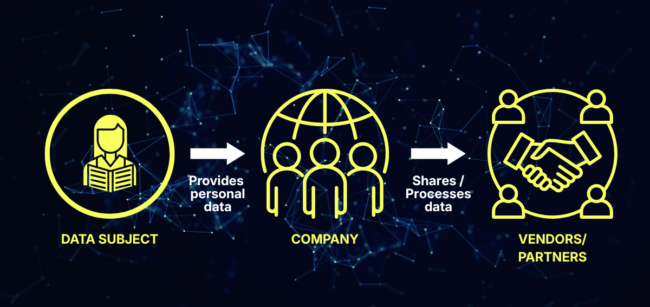
A DPA is a contract between a controller and a processor that explains
what personal data is processed, why, and how. It follows GDPR rules in
Articles 28–36 and sets out everyone’s responsibilities, including any sub-processors.
Not a “sign and forget” document: Per EDPB Opinion 22/2024, controllers should
keep monitoring that processors (and sub-processors) actually follow Article 28(3).
The DPA is essential, but ongoing oversight is needed to stay GDPR-compliant.
The same details are described in the records of processing activities. We recommend first creating your records of processing activities and then filtering activities related to the processor or controller you are signing the data processing agreement with.
In GDPR Register, activities and data processing agreements are interconnected. So you will easily find such information and integrate it into your agreement.
Learn more about GDPR Register.
Legal compliance of all involved parties is the primary reason for DPAs. As a central pillar of operating business is processing personal data and exchanging it with other businesses, it is necessary for businesses to construct a lawful DPA with the party they exchange personal information with in order to avoid injustice and conflict of interest in the future.
GDPR doesn’t have legal restrictions on the form of the DPA, however, exceptionally in situations where the processor is located outside the EU and international data transfer happens, there are some specific requirements to the format of documentation, such as standard contractual clauses (SCC), binding corporate rules (BCR), etc. It is advised to have a DPA as a separate document for clarity and security.
Furthermore, a key benefit of DPA is risk minimisation referring to how your organisations can minimise the impact of data breaches or unauthorised access by having clear definitions of controller and processor roles. Additionally a DPA demonstrates how your organisation protects the rights of individuals hence having a strong emphasis on individual rights protection.
Similarly, building stakeholder trust is very crucial for data protection. DPAs aim to build this trust through transparency by including adequate security measures and data processing protocols. Moreover, with a comprehensive DPA, parties involved may enhance collaboration which strengthens efficient data processing. In general, DPAs can help support your long-term business relationships.
Additionally, according to Articles 28 through 36 of the GDPR, on an individual basis, if you exchange personal data with other parties, you should have a DPA in place.
According to Article 26 of the GDPR, joint controllers are two or more controllers jointly determining the purposes and means of processing. Regardless of those arrangements, each controller remains responsible for complying with all the obligations of controllers under the GDPR.
The Joint Controller Agreement must provide certainty and could be used to evidence transparency and accountability. Indeed, in case of non-compliance with the agreed allocation provided in the arrangement, its binding nature allows one controller to seek the liability of the other for what was stated in the Joint Controller Agreement as falling under its responsibility. The essence of such agreements should be made available to data subjects.
Various EU regulations refer to data protection and DPAs. The following regulations refer to the obligation of signing DPAs or equivalent contracts, or otherwise are involved in data handling:
Similarly, different countries have adopted the requirement of signing DPAs just like EU’s GDPR:
For international trade and international cooperation, personal data must flow into and out of the European Union. A Third Country is any country outside the European Economic Area (the “EEA”), but the transfer of such personal data from the EU to controllers and processors located outside the EU should not reduce the level of protection of the individuals concerned. The General Data Protections Regulation Chapter V should therefore be strictly followed when transferring data to third countries or international organisations.
There are different basis for transfer available and they influence how the Data Processing Agreement is formulated.
The existence of an “adequacy decision” should be taken into account before transferring personal data to a third country. An adequacy decision means that the European Commission has determined that a third country or an international organization provides an adequate level of data protection.
The European Commission considers factors like laws, adherence to human rights and freedoms, national security, data protection authority, and legally binding agreements the country has made regarding data protection when determining whether the level of protection is adequate.
List of Countries that Provide Adequate Level of Personal Data Protection:
For those countries there is no requirement of providing additional safeguards and standard Data Processing Agreement can be used.
If the country where the personal data is transferred does not have the Adequacy Decision, the data can still be transferred if the controller or processor has implemented appropriate safeguards. Such protections could be:
The European Commission has approved these sample data protection clauses, which when incorporated into a Data Processing Agreement allow for the free flow of personal data. The SCCs include rights for the people whose personal data is transferred as well as contractual obligations for the Data Exporter and Data Importer. These rights are directly enforceable by individuals against the Data Importer and Data Exporter. Between a controller and another controller, there are two sets of standard contractual clauses for restricted transfers, and between a controller and a processor, there is only one set.
The European Commission has made updated Standard Contractual Clauses available on 4th of June 2021. Therefore, from December 2022, all organizations must use the 2021 SCCs for already existing and new transfers. Nevertheless, DPAs are expected to emphasise the necessity of TIAs, and where necessary supplementary safeguards in addition to SCCs in order to ensure compliance with GDPR, EDPB guidelines, and Schrems II judgement.
Binding Corporate Rules are internal codes of conduct that operate within a multinational group of companies and are legally binding. They are applicable to the transfers of personal data from the group’s EEA entities to its non-EEA entities. This group could be a corporation or a collection of businesses that are involved in a joint economic activity, like joint ventures or franchises. BCRs are legally binding data protection rules that have been authorised by the relevant Data Protection Authority.
Two different BCR types may be approved: BCR for Controllers, which group entities use to transfer data under their control, like employee or supplier information, and BCR for Processors, which are used by organizations that act as processors for other controllers and are typically added as an addendum to the Service Agreement or Data Processing Agreement. Additional guidelines for the use of BCRs as a suitable safeguard for personal data transfers are provided in GDPR Article 47.
The GDPR’s Article 40 (3) introduced the use of Codes of Conduct as a transfer mechanism in certain situations. Codes, which are optional, specify specific data protection guidelines for various controller and processor categories. They can be a useful and effective accountability tool, providing a thorough explanation of the most appropriate, ethical, and legal behavior within a sector.
Therefore, from the perspective of data protection, codes can serve as a guide for controllers and processors who create and carry out GDPR-compliant data processing activities that give practical meaning to the data protection principles outlined in European and national law.
Codes of Conduct that are applicable to the processing of personal data by controllers and processors in more than one EU Member State and for which the EU Commission has adopted an implementing act, along with legally-binding agreements made by the controller or processor in the third country, may be used as a transfer tool.
The Article 42(2) of the GDPR states that certification mechanisms may be created to show the existence of suitable safeguards provided by controllers and processors in third countries. Additionally, these controllers and processors would agree to adhere to the safeguards, which would include provisions for data subject rights.
According to Article 46 (2)(a) of GDPR, a restricted transfer may be made by an organisation if it is one public authority or body transferring to another public authority or body. This agreement or other document must contain enforceable rights and practical resources for the people whose personal data is transferred. This is not a suitable safeguard if either the receiving organisation or the sending organisation is a private entity or an individual. A public authority or body may consider an administrative arrangement that includes enforceable and effective individual rights as an alternative if it lacks the authority to enter into legally binding and enforceable agreements (Article 46 (3)(b) of GDPR).
Derogations under Article 49 are exceptions to the general rule that states that personal data may only be transferred to a third country if that country offers an adequate level of protection. Before using the derogations allowed by Article 49 (1), a Data Exporter should first try to frame transfers with one of the mechanisms guaranteeing adequate safeguards listed above. These exemptions or derogations permit transfers in certain circumstances, such as those based on consent, for the performance of a contract, for the assertion of legal claims, to safeguard the data subject’s vital interests when they are unable to give consent, or for significant public interest considerations. Additionally, the EDPB emphasises that these derogations can be used for systematic or large-scale transfers, hence they are strictly exceptional and considered in case-specific situations.
If required by GDPR, the data processor shall appoint a Data Protection Officer and both parties must agree on a periodic review of the terms of the DPA. Regulators advise DPAs to be continuously updated according to changes in processing activities, sub-processors and legal obligations.
There are various publicly available DPA templates on our website that can be used. However, ensure to responsibly only use the templates as a baseline for your DPA and customize according to your specific data flows, jurisdictions, risks and technologies.
Keeping track of how your company uses personal data may sound complicated, but under the GDPR it’s required for most […]

Press release The European Commission’s latest guidelines introduce additional restrictions for developers of online platforms and services that are used […]