Webinars

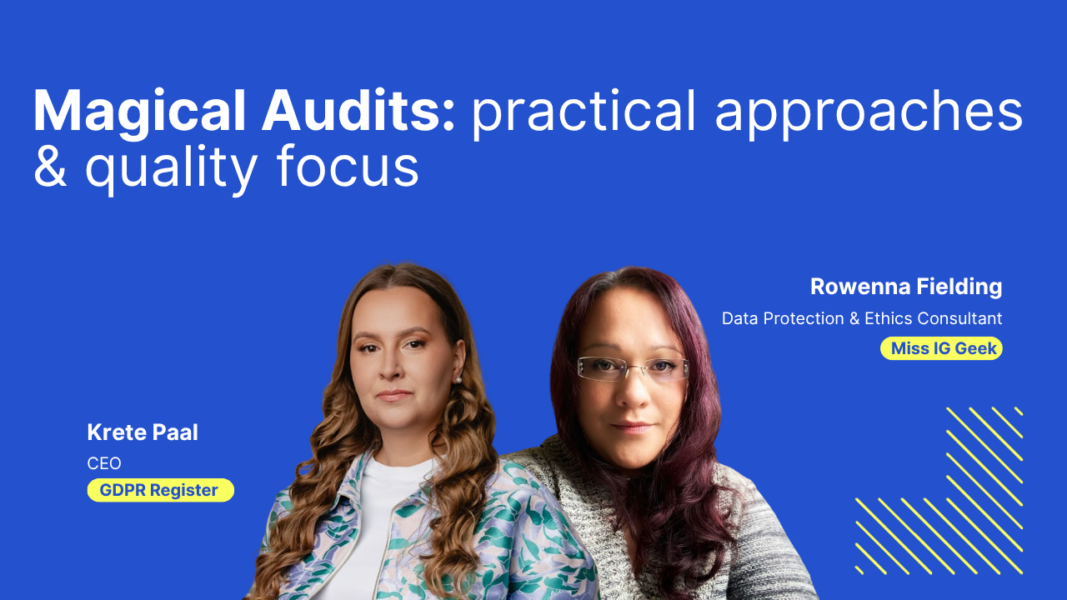
Magical Audits

Practical approaches & quality focus
Date And Time 08.04.2026
14:00
Location Online

Why Most GDPR Audits Fail:
Key Takeaways from Our Webinar with Rowenna Fielding

Most GDPR audits do not fail because organisations do not care. They fail because the audit starts without a clear objective, focuses too heavily on paperwork, and does not test whether privacy measures actually work in practice.

That was the core message from our recent webinar, Magical Audits: Rethinking the GDPR Audit, where GDPR Register CEO and co-founder Krete Paal spoke with data protection expert and certified data ethics professional Rowenna Fielding about what meaningful GDPR auditing should really look like.

Webinar recap

Key takeaways from the conversation

In our webinar Magical Audits: Rethinking the GDPR Audit, Krete Paal and Rowenna Fielding explored what makes a GDPR audit useful in practice — and why so many audits fail to create meaningful change.

01

Many organisations audit without a clear objective

One of the biggest problems is that organisations often carry out audits because they feel they have to. But a “compliance audit” can mean very different things depending on whether the goal is appearance, risk management, internal quality, or real rights protection.


02

A green report can create a false sense of security

A recurring theme in the webinar was the gap between presentation and reality. When audits uncover issues, management may focus more on making findings look better than on fixing the underlying problem.

03

Most audits miss the thing that matters most: outcomes

Many audits check whether a policy, notice, or process exists. Far fewer test whether those measures actually work. That means organisations often miss the real question: are people’s rights and freedoms being protected in practice?

04

A meaningful audit should focus on people, not just paperwork

Policies, notices, and records matter only if they are understood, used, and reflected in day-to-day decision-making. One practical tip from the session: ask people how they feel about the processes they work with, not just what they do.

05

Smaller organisations should start with the basics

For startups and smaller teams, the best starting point is often not a huge checklist. It is understanding what the business does, where personal data is processed, whether staff have meaningful awareness, and what the organisation tells people about data use.

Final thought: Before starting a GDPR audit, be clear about what you want it to achieve. A meaningful audit is not just about whether documents exist — it is about whether your controls work and whether people are actually being protected in practice.

Final thought

One of the clearest messages from the webinar was this: before starting a GDPR audit, be clear about what you want it to achieve.

A meaningful audit is not just about whether documents exist. It is about whether your organisation understands its data practices, whether its controls work, and whether people are actually being protected in practice.

That is what makes an audit useful — not just complete.

Speakers

Rowenna Fielding
Data ethics professional and data protection consultant
Rowenna Fielding (aka Miss IG Geek) is a certified data ethics professional and data protection consultant with over a decade of experience helping organisations across all sectors get privacy right — not just on paper, but in practice.

Known for making complex topics human, accessible and occasionally funny, Rowenna is a trusted voice for privacy professionals who want substance over spin.
Krete Paal
CEO
Krete Paal is the CEO of GDPR Register, where she leads the development of AI-powered tools that make privacy compliance scalable and practical for organisations across Europe.

With a strong background in data protection and legal tech — from heading Veriff’s DPO Office to earlier work with the Estonian Police and Border Guard, Krete combines deep regulatory expertise with product leadership.

At GDPR Register, she brings a forward-looking perspective on how AI can support GDPR compliance and align with emerging regulations, turning complex requirements into clear, actionable workflows.
PREVIOUS
EU AI Act turns 1: Challenges, Opportunities, and What’s Next
Krete Paal and Diana Karyan Webinar on Navigating Privacy in Fintech
NEXT
FinTech Compliance 2026