DPIA Software & Privacy Assessments | LIA
DPIA Software for GDPR Compliance & LIA
Assess, justify & demonstrate compliance with confidence.
Trusted by 10K+ teams
Keep your privacy risks identified and under control
A Data Protection Impact Assessment (DPIA) helps you evaluate how data processing may affect individuals’ rights and freedoms, ensuring that high-risk activities are assessed before launch.
Understanding potential impacts and documenting mitigation measures gives you confidence when presenting to management or regulators.
Centralise all your assessments and evidence in one secure space, so your team can track progress, collaborate easily, and stay audit-ready at all times.

Adapt every assessment to your organisation
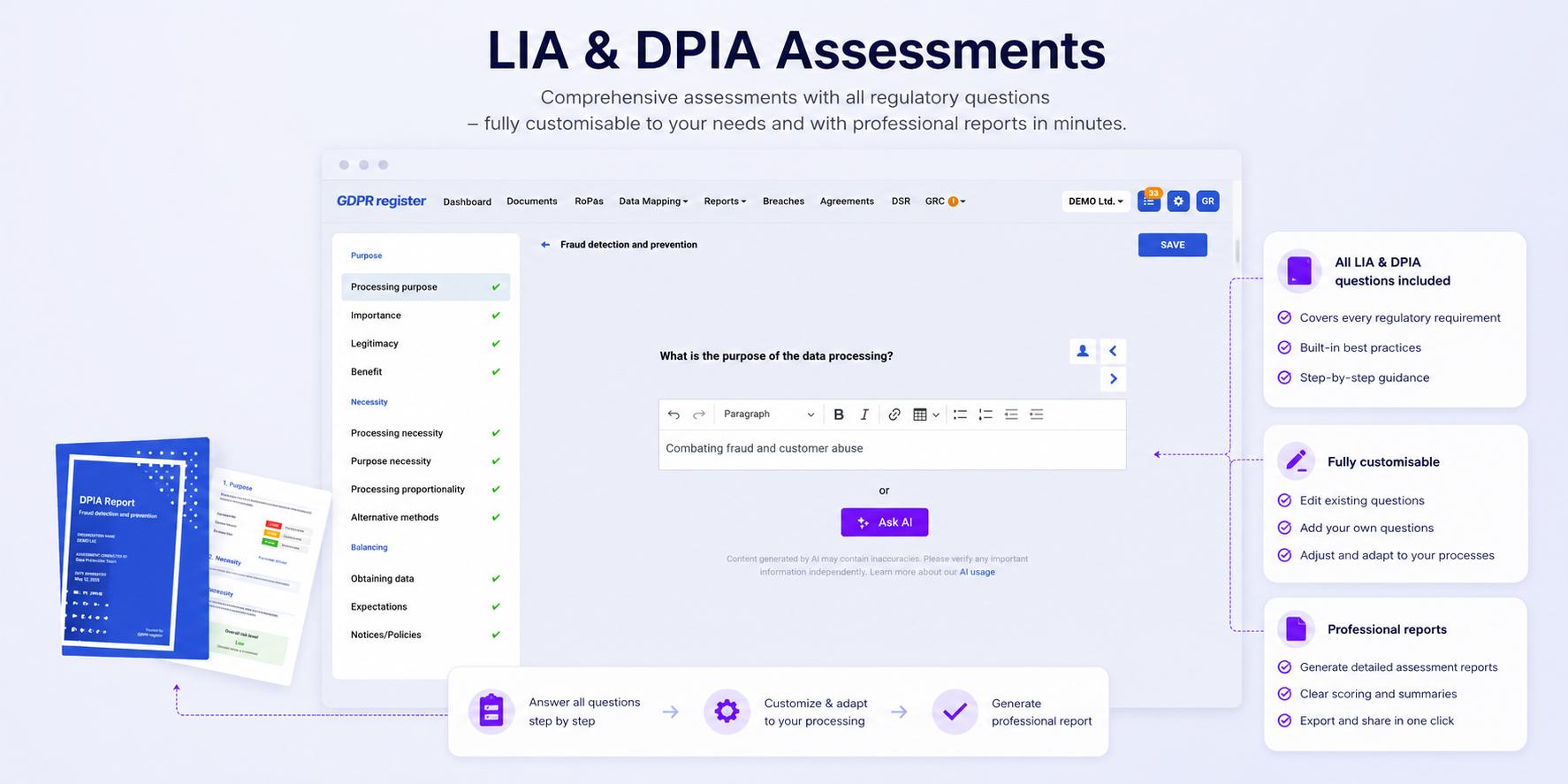
Start with comprehensive LIA and DPIA question sets, then adjust them to match your organisation’s processes, policies and risk methodology.
Choose which questions to include
Enable relevant questions and hide those you do not need. LIA and DPIA question sets can be managed separately.
Add your own questions
Add organisation-specific questions for internal policies, sector requirements, controls and review procedures.
Edit sections and wording
Update section names, questions and guidance so assessments use terminology familiar to your teams.
Build the right assessment structure
Add sections and group related questions into a clear, step-by-step assessment workflow.

FAQ
Everything you need to know about DPIAs, LIAs, and audit-ready privacy assessments
How does DPIA and LIA software help your team?
Legal teams can use it to review reasoning, validate legal bases, and make sure assessments are properly documented. Privacy and compliance teams can identify risks, apply safeguards, track approvals, and keep records audit-ready. Product teams can contribute operational context early, so privacy considerations are built into projects before launch rather than added later.
The result is a more consistent assessment process, better cross-functional collaboration, and less time spent chasing missing information.
What is a DPIA?
In simple terms, it helps an organization look at how personal data will be used, what risks that creates for individuals, and what safeguards should be put in place to reduce those risks. DPIAs are especially important when data processing is likely to result in a high risk to people’s rights and freedomss
What is a Legitimate Interest Assessment?
It helps answer three key questions: what is the legitimate interest, is the processing necessary, and do the individual’s rights override that interest. In practice, an LIA helps organisations show their reasoning, assess fairness, and document why legitimate interest is appropriate in a specific case.
When should you conduct a DPIA or LIA?
You should conduct an LIA when you plan to rely on legitimate interest as the legal basis for processing personal data. Common examples include certain internal administrative purposes, fraud prevention, direct marketing, or some types of analytics and security monitoring.
In both cases, the assessment should happen early enough to influence the design of the activity, not after decisions have already been made.
What’s included in an audit-ready assessment?
For a DPIA, this usually includes the processing description, necessity and proportionality analysis, risk identification, mitigation measures, internal review, approvals, and a clear record of decision-making. For an LIA, it should include the legitimate interest, necessity test, balancing test, safeguards, justification, and review trail.
A strong assessment should be easy to understand, easy to revisit, and ready to show during internal reviews, customer due diligence, or regulator scrutiny.
DPIA and LIA software vs Excel or manual workflows
Spreadsheets usually do not guide users through the full legal and risk logic of an assessment. They can lead to inconsistent answers, missing approvals, version control issues, and limited visibility across teams. Manual workflows also make it harder to track progress, standardise quality, and maintain a reliable audit trail.
DPIA and LIA software gives teams a repeatable process, structured inputs, clear ownership, approval flows, and centralised records. It reduces admin work while improving consistency, traceability, and readiness for audits or customer requests.
From complex assessments to clear, confident decisions
Complete structured privacy assessments, understand the risks and document your reasoning in one guided workflow.
Turn assessments into confident decisions
Identify risks, evaluate impacts and document your reasoning with ease. Create Data Protection Impact Assessments and Legitimate Interest Assessments that support GDPR compliance in one central, structured workflow.
- Assess necessity, proportionality and individual impact
- Record risks, safeguards and residual risk
- Keep decisions and supporting reasoning audit-ready
Guided by AI, backed by expertise
Receive step-by-step support from the AI Assistant while you work. Get tailored explanations, risk insights and compliance suggestions in real time, helping you complete each assessment faster and with greater confidence.
- Get contextual guidance for each assessment question
- Improve incomplete or unclear responses
- Identify risks and possible safeguards as you work
Trusted by 10K+ teams
Balance business needs with individual rights
A Legitimate Interest Assessment helps you determine whether your organisation’s interests lawfully justify the use of personal data — and how to balance those interests against people’s privacy.
Follow a clear, step-by-step framework to document your reasoning, safeguards, and outcomes, creating a solid record for accountability and transparency.
Generate and store every assessment in one place, making it simple to review, update, and demonstrate compliance whenever needed.
