


UK Information Commissioner’s Office has published detailed guidance on the Right of Access.
The right of access is a fundamental right under data protection law. And it has never been more necessary. In […]
Organisations today need more than spreadsheets and scattered documentation to stay compliant with privacy laws.
The best data protection software helps businesses manage personal data, maintain records of processing activities, handle risk assessments, track vendors, respond to data subject requests, and demonstrate accountability.
In this article, we compare the best data protection software tools for GDPR compliance in 2026 and explain how to choose the right solution for your organisation.
Data protection software is software that helps organizations manage, protect, and govern personal data throughout its lifecycle. Depending on the solution, it may include tools for records of processing activities, data retention, privacy risk assessments, consent tracking, vendor management, incident management, and reporting.
For many organisations, data protection software is also a practical way to support GDPR compliance. Instead of managing privacy tasks manually, teams can use centralised tools to document processing activities, assess risks, assign responsibilities, and maintain evidence of compliance.
As privacy obligations grow, manual compliance processes become harder to manage. Legal teams, data protection officers, security teams, and operational teams often need to work together across multiple systems and business units. Without a dedicated tool, important information can be missed, duplicated, or become outdated.
The right data protection software helps organizations:
Different tools solve different parts of the privacy and compliance process. Some are built for full privacy program management, while others focus on specific areas such as consent, security, or data discovery.
Below are some of the most relevant categories and tools to consider.
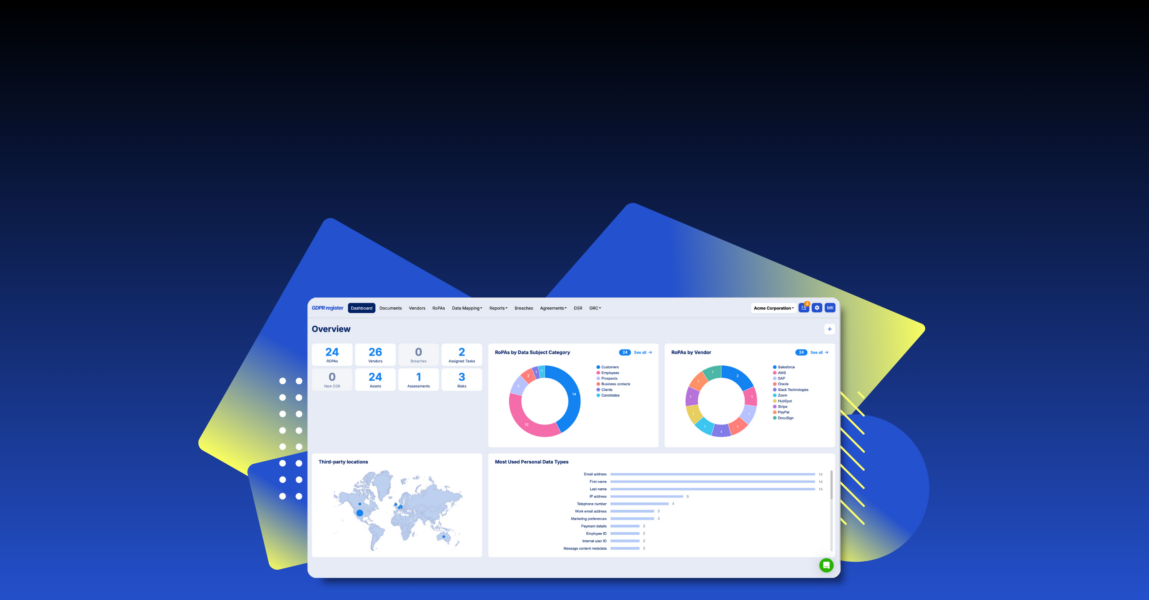
GDPR Register is a data protection software solution built to help organizations manage privacy compliance in a practical and structured way. It is particularly useful for teams that need a central place for records of processing activities, assessments, vendor management, retention rules, incident management, and accountability documentation.
Key strengths:
Best for:
Organisations looking for a practical privacy management platform focused on accountability and operational compliance.
Microsoft Purview Compliance Manager is useful for organizations already working within the Microsoft ecosystem. It supports compliance tracking, assessment workflows, and data governance efforts across Microsoft environments.
Key strengths:
Best for:
Companies already relying heavily on Microsoft 365 and related services.
CookieHub focuses on consent and cookie compliance. While it is not a complete data protection software platform on its own, it can be a valuable component of a broader privacy toolkit.
Key strengths:
Best for:
Organisations that need a simple solution for cookie consent management.
Amazon Macie is more focused on data discovery and security within AWS environments. It helps organizations identify and monitor sensitive data stored in their cloud environment.
Key strengths:
Best for:
Organisations with personal data stored and processed in AWS.
Azure Information Protection helps classify and protect sensitive information in organizations using Microsoft Azure and related Microsoft services.
Key strengths:
Best for:
Organisations operating in Azure-heavy environments that need stronger information protection and classification.
CNIL’s PIA tool is a useful option for organizations specifically looking for support with Data Protection Impact Assessments. It is not a full privacy management platform, but it can be a practical tool for DPIA work.
Key strengths:
Best for:
Teams that mainly need a DPIA-focused solution.
ARX is a technical solution for anonymization and de-identification. It is relevant where data minimization and anonymization play an important role in the organization’s privacy strategy.
Key strengths:
Best for:
Organisations with stronger technical capability and anonymization needs.
The best data protection software depends on your organization’s size, complexity, technical environment, and privacy maturity.
When evaluating tools, ask the following questions:
Some companies need a full privacy management platform. Others mainly need consent management, DPIA support, data discovery, or accountability documentation.
If legal, compliance, HR, procurement, IT, and security all need to collaborate, choose software with strong role management and workflow support.
A standalone cookie tool or assessment tool may be enough for a small business. Larger organizations usually benefit more from a broader platform.
If your organization is deeply tied to Microsoft or AWS, ecosystem compatibility may be a major factor.
A strong data protection software solution should help you document actions, store evidence, assign responsibilities, and generate reports when needed.
Not every company needs the same module set, but the most valuable features usually include:
These terms are often used interchangeably, but they are not always identical.
Data protection software is the broader term. It can include privacy operations, data governance, classification, retention, discovery, and security-related controls.
GDPR compliance software usually focuses more specifically on the obligations arising under GDPR, such as records of processing activities, lawful basis documentation, assessments, privacy notices, vendor oversight, and accountability.
For many businesses, the best solution combines both perspectives: practical privacy operations and strong GDPR compliance support.
Data protection software can be useful for:
The more complex your data processing activities are, the more valuable a centralized privacy management tool becomes.
The best data protection software depends on your needs. Some organizations need full privacy management, while others need only consent, DPIA, or security-focused tools.
Not always, but it can make GDPR compliance much easier. As organizations grow, software helps reduce manual work and improves consistency, visibility, and accountability.
The most important features usually include records of processing activities, DPIAs, LIAs, vendor management, retention rules, incident management, and data subject request tracking.
Yes. Small businesses may not need enterprise-level tools, but even simple software can help manage privacy documentation and reduce compliance risk.
Choosing the right data protection software is not only about compliance. It is also about making privacy management more practical, more structured, and easier to maintain over time. The right tool should fit your organization’s actual workflows, support accountability, and reduce the burden of manual privacy administration.
If your organization is looking for a practical solution for records, assessments, accountability, and privacy operations, it is worth comparing software based on your real use cases instead of choosing based on feature lists alone.
The right of access is a fundamental right under data protection law. And it has never been more necessary. In […]
Data protection authorities in Europe are gaining confidence and competence, which is reflected in the statistics of penalties for violators. […]