EU AI Act Compliance
BUILT FOR CROSS-FUNCTIONAL TEAMS
Built for privacy, legal, compliance, and product teams
Give every team involved in AI governance a shared place to classify systems, document decisions, and understand what needs action.
Privacy & DPO
Connect AI system classification with DPIAs, RoPAs, vendor reviews, and accountability documentation.
Legal & Compliance
Create a consistent process for identifying AI Act roles, classifying risk, and documenting obligations.
Product & Engineering
Understand when AI features require review before launch and what safeguards need to be in place.
Management
Get a clear overview of AI risk exposure, high-risk systems, and unresolved follow-up actions.
HOW IT WORKS
How GDPR Register helps you prepare for the EU AI Act
Move from first inventory to audit-ready AI governance with a clear, structured workflow.
Identify AI systems
Create a central inventory of AI tools used across teams, vendors, and group companies.
Classify risk
Use guided questions to classify systems as minimal, limited, high-risk, or unacceptable.
Map your role
Understand whether your organisation acts as a provider, deployer, or both.
Connect assessments
Link AI Act classification with DPIAs, vendor reviews, RoPAs, risk treatment, and internal approvals.
Keep records audit-ready
Track decisions, dates, owners, obligations, and follow-up actions in one place.
Ready to make AI Act compliance manageable?
AI ACT COMPLIANCE STARTS WITH VISIBILITY
Create your AI Register. Classify risk. Stay audit-ready.
TURN AI RISK INTO CLEAR DECISIONS
Balance innovation with compliance obligations
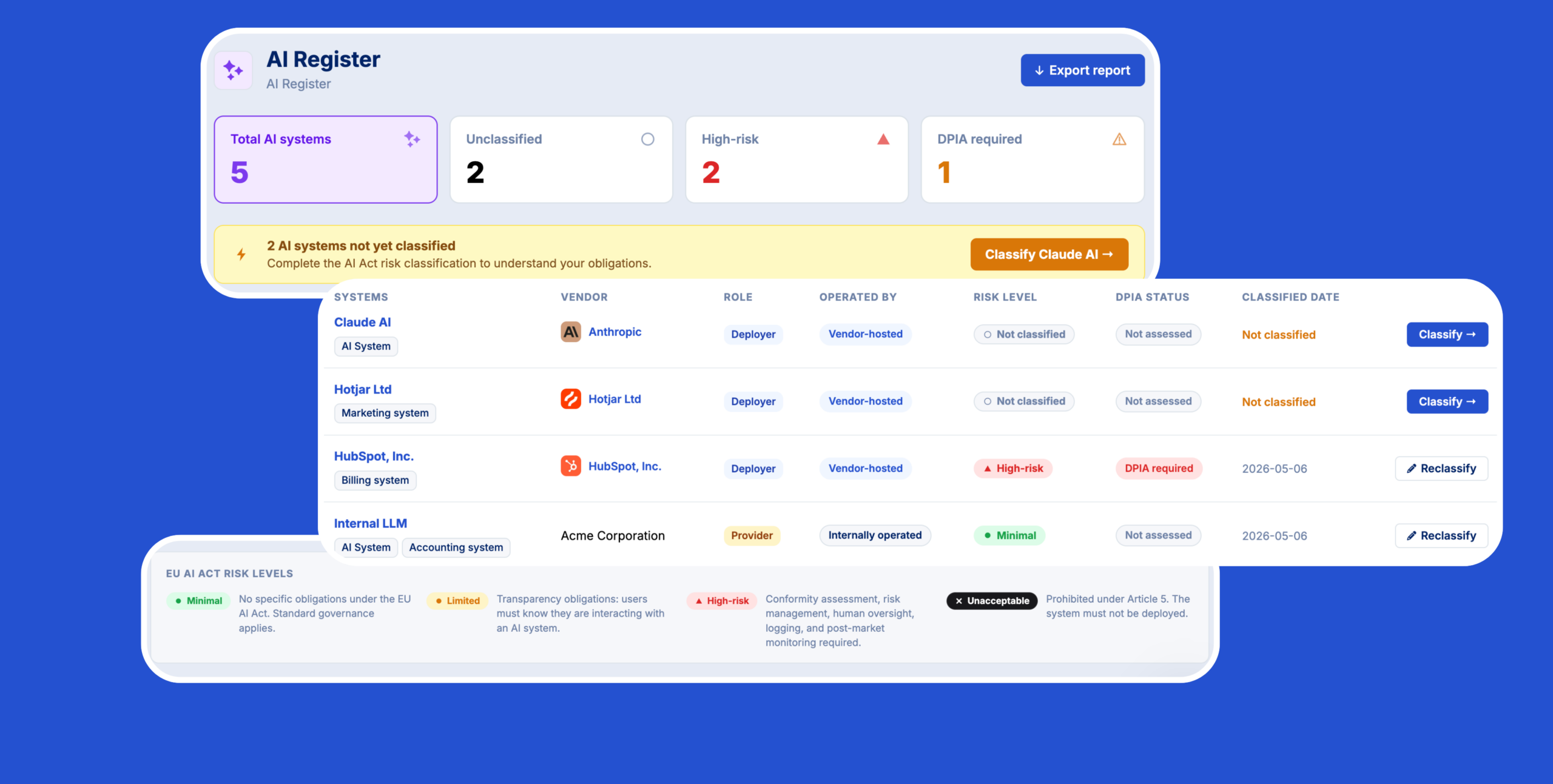
AI systems can create legal, operational, and reputational risk long before they reach production. GDPR Register helps your team evaluate those risks early, define mitigation measures, and document the reasoning behind each decision.
Connect AI Act classification with DPIAs, vendor reviews, risk treatment, and internal approvals, so every AI system has a clear compliance trail.
The result is a practical governance process that supports innovation while keeping accountability, transparency, and individual rights in focus.
FROM SPREADSHEETS TO STRUCTURE
Replace scattered AI spreadsheets with one structured workflow
Move from fragmented AI inventories and ad hoc reviews to a clear, audit-ready process for AI Act compliance.
| Manual AI inventory | GDPR Register AI Act Compliance |
|---|---|
| Scattered spreadsheets | Central AI Register |
| Inconsistent classification | Guided AI Act classification |
| No clear ownership | Provider, deployer, vendor, and owner tracking |
| Hard to prove decisions | Documented classification history |
| Separate privacy workflows | Connected DPIAs, RoPAs, vendor reviews, and approvals |
| Limited audit readiness | Clear records and follow-up actions |
GUIDED AI ACT CLASSIFICATION
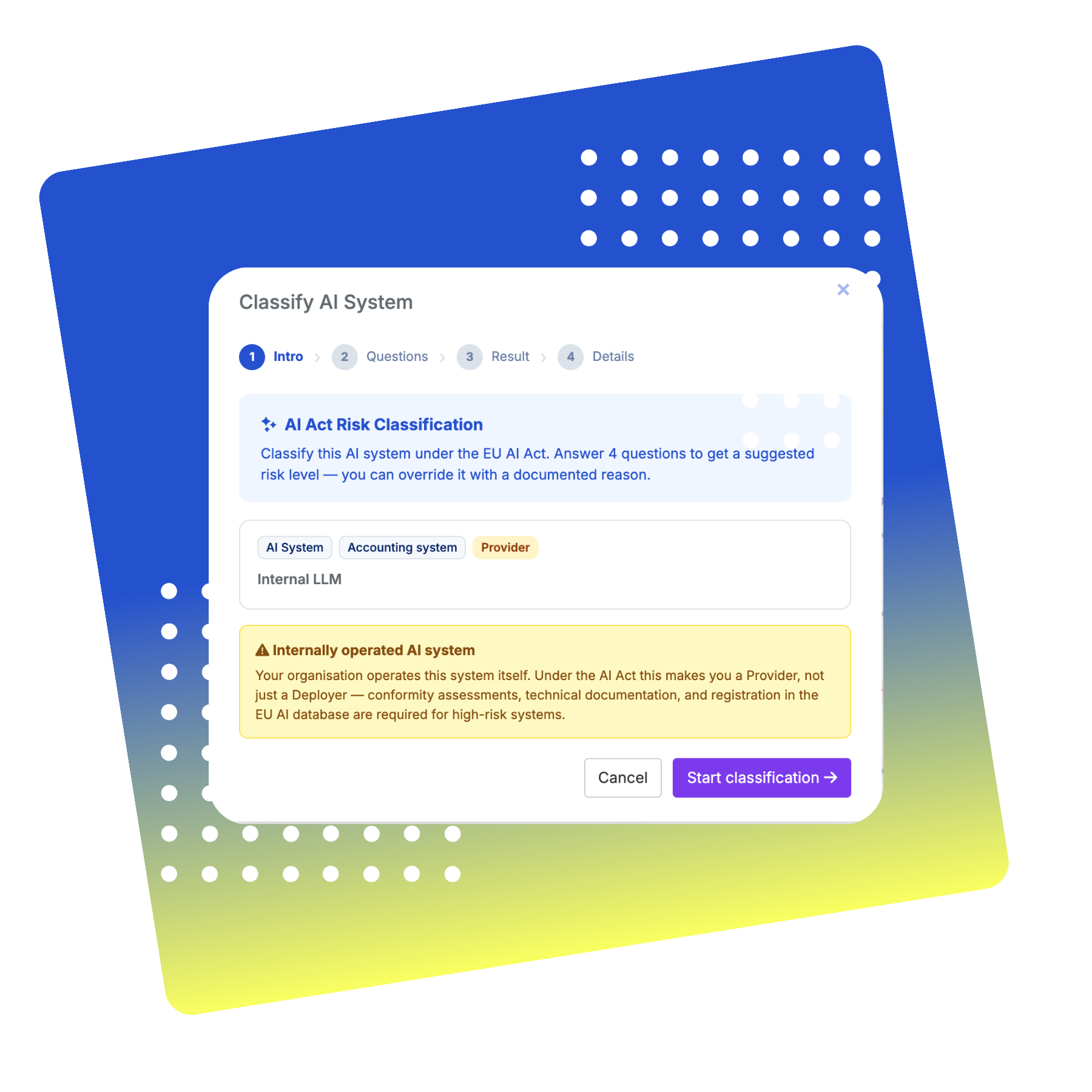
Answer simple questions. Get a clear risk result.
Classifying AI systems under the EU AI Act can be complex, especially when teams need to understand whether a system is minimal, limited, high-risk, or potentially prohibited.
GDPR Register turns classification into a guided workflow. Answer structured questions about the system’s purpose, data use, decision-making impact, sector, and potential prohibited practices. The platform then suggests a risk classification and explains what obligations may apply.
Teams can review the result, document the reasoning, override the suggested classification where needed, and continue with the right follow-up actions.

FROM AI INVENTORY TO ACTIONABLE GOVERNANCE
Keep AI risks visible, classified, and under control
AI tools are often adopted across teams before legal, privacy, or compliance teams have full visibility.
GDPR Register gives you a structured way to document AI systems, classify EU AI Act risk levels, assign roles, and understand which systems require further assessment.
Use one clear register to connect AI Act classification with your existing GDPR workflows, including DPIAs, vendor reviews, RoPAs, and accountability documentation.

FAQ
Everything you need to know about DPIAs, LIAs, and audit-ready privacy assessments
What is an AI Register?
Why do we need an AI Register for AI Act compliance?
Does every AI system need to be classified?
What AI Act risk levels does GDPR Register support?
Minimal risk — systems with no specific AI Act obligations, where standard governance may be sufficient.
Limited risk — systems where transparency obligations may apply.
High-risk — systems that may trigger stricter AI Act requirements.
Unacceptable risk — systems that fall under prohibited AI practices and should not be deployed.